
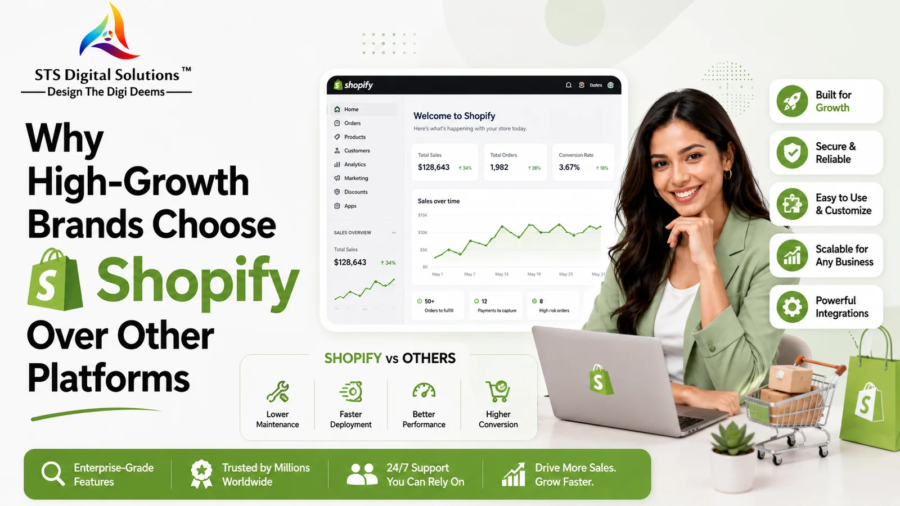
Growing ecommerce brands choose Shopify because it offers a reliable, secure, and scalable platform that simplifies store management while supporting SEO, AI-powered search visibility, fast performance, and business growth. Its extensive app ecosystem and ease of use make it a strong choice for brands planning long-term expansion.
Introduction
Choosing the right ecommerce platform is one of the most important decisions for any online business.
A platform isn’t just where your products are displayed—it influences your website’s speed, customer experience, search visibility, security, and future scalability.
Many businesses begin with one platform only to migrate later because it no longer supports their growth.
Over the past few years, Shopify has become one of the most widely adopted ecommerce platforms for startups, D2C brands, and enterprise businesses alike.
But why are so many growing brands choosing Shopify over alternatives?
Let’s explore the key reasons.
1. Shopify Is Built to Scale
One of Shopify’s biggest advantages is scalability.
Whether you’re selling ten products or ten thousand, Shopify is designed to handle increasing traffic and orders without requiring major infrastructure changes.
As your business grows, your platform should support that growth instead of becoming a technical challenge.
2. Faster Website Performance
Website speed directly affects:
- User experience
- Conversion rates
- Organic rankings
- Customer satisfaction
Shopify provides optimized hosting and a global content delivery network (CDN), helping stores deliver pages quickly across different locations.
While merchants still need to optimize images and apps, Shopify offers a strong technical foundation for performance.
3. Strong SEO Capabilities
Contrary to a common misconception, Shopify can perform very well in search results when implemented correctly.
It supports:
- Custom title tags
- Meta descriptions
- Clean URLs (within platform structure)
- XML sitemaps
- Mobile-friendly themes
- HTTPS security
- Structured data through themes or apps
Combined with high-quality content and technical optimization, these features help brands compete for valuable organic traffic.
4. Security Without Complexity
Security is essential for every ecommerce business.
Shopify manages many technical responsibilities, including:
- SSL certificates
- Platform updates
- Hosting infrastructure
- PCI compliance for payments
This allows businesses to spend more time improving marketing and customer experience instead of maintaining servers.
5. Built for AI-Driven Search
Search is evolving rapidly.
As AI-powered search experiences become more common, ecommerce websites need:
- Fast loading pages
- Structured content
- Clear product information
- Helpful buying guides
- Strong internal linking
Shopify supports these strategies when paired with effective SEO and content marketing.
The platform itself isn’t a ranking factor, but it provides a solid environment for implementing AI-friendly SEO practices.
6. An Extensive App Ecosystem
Every business has unique requirements.
Shopify’s app marketplace allows merchants to extend functionality for areas such as:
- Email marketing
- Loyalty programs
- Reviews
- Inventory management
- Analytics
- SEO
- Shipping
- Upselling
Choosing apps carefully is important, as installing too many can affect performance.
7. Excellent User Experience
One reason founders appreciate Shopify is its ease of use.
Business owners can manage:
- Products
- Orders
- Customers
- Discounts
- Inventory
- Marketing campaigns
without requiring advanced technical knowledge.
This simplicity allows teams to focus on business growth rather than platform management.
Shopify vs Other Ecommerce Platforms
Different platforms suit different business needs.
For example:
- WooCommerce offers greater flexibility but often requires more technical maintenance.
- Magento (Adobe Commerce) is powerful for large enterprises but typically demands higher development resources.
- Shopify balances usability, scalability, and reliability, making it a popular choice for many growing D2C brands.
The best platform depends on your budget, technical expertise, and long-term goals.
Common Mistakes Brands Make After Choosing Shopify
Selecting the right platform is only the beginning.
Many stores still struggle because they:
- Ignore technical SEO.
- Publish duplicate product descriptions.
- Install unnecessary apps.
- Neglect content marketing.
- Skip internal linking.
- Fail to optimize collection pages.
- Never update existing content.
Even the best platform requires a well-planned growth strategy.
Best Practices for Shopify Success
To maximize Shopify’s potential:
- Optimize every product page.
- Create informative buying guides.
- Improve collection page SEO.
- Monitor Core Web Vitals.
- Use structured data where appropriate.
- Build topical authority through blog content.
- Regularly review Search Console performance.
These practices contribute to stronger long-term visibility.
Frequently Asked Questions
Is Shopify good for SEO?
Yes. Shopify offers a solid technical foundation for SEO, but rankings ultimately depend on content quality, technical optimization, user experience, and overall website authority.
Can Shopify support large businesses?
Yes. Shopify serves businesses of various sizes, including rapidly growing brands and enterprise-level organizations.
Is Shopify better than WooCommerce?
Neither platform is universally better. Shopify emphasizes simplicity and managed infrastructure, while WooCommerce offers greater customization for businesses with technical resources.
Conclusion
Shopify has become a preferred platform for many growing brands because it combines reliability, scalability, security, and ease of use.
However, choosing Shopify alone won’t guarantee business success.
Long-term growth comes from combining the right platform with effective SEO, content marketing, technical optimization, and a customer-focused strategy.
Businesses that consistently invest in these areas are better positioned to build sustainable organic visibility and long-term ecommerce growth.
Why Choose My Adwise?
At My Adwise, we help Shopify and D2C brands grow through technical SEO, Shopify SEO, AI Overview optimization, content strategy, and performance-driven digital marketing.
Our objective isn’t simply to improve rankings—it’s to help businesses attract qualified customers, increase conversions, and build sustainable long-term growth through search.