
SEO helps D2C brands increase monthly sales by attracting high-intent customers through Google Search and AI-powered search experiences. When product pages, category pages, and content are optimized for search intent, businesses receive consistent organic traffic that continues even when advertising budgets are reduced.
Introduction
If someone had asked this question five years ago, the answer would have been simple:
That statement is no longer completely true.
Today, millions of users receive answers directly from Google AI Overview, Gemini, ChatGPT, and other AI-powered search platforms before they even click on a website.
Instead of showing ten blue links, AI tries to answer the user’s question immediately and then recommends a handful of trusted sources.
This creates a new challenge for businesses.
The question is no longer:
The new question is:
“How do I become one of the websites AI trusts enough to recommend?“
At My Adwise, we believe this shift is one of the biggest changes in digital marketing since Google’s original search algorithm. Businesses that understand AI Search today will be better positioned to earn organic visibility over the next several years.
Search has evolved through several major stages.
Phase 1: Keyword Search
In the early days, search engines matched pages mainly by keywords. If a page repeated the target keyword often enough, it had a higher chance of ranking.
This led to practices like keyword stuffing, which produced poor user experiences.
Phase 2: Quality Content
Google introduced updates that rewarded useful, original, and trustworthy content. Websites needed to demonstrate expertise rather than simply repeat keywords.
Phase 3: AI-Powered Search
Today, AI goes beyond matching keywords. It tries to understand:
- What the user is really asking.
- Which sources are reliable.
- Whether the information is complete.
- Which content best solves the problem.
This is why traditional SEO alone is no longer enough.
What Does AI Actually Look For?
A common misconception is that AI recommends the website with the highest number of backlinks or the highest keyword density.
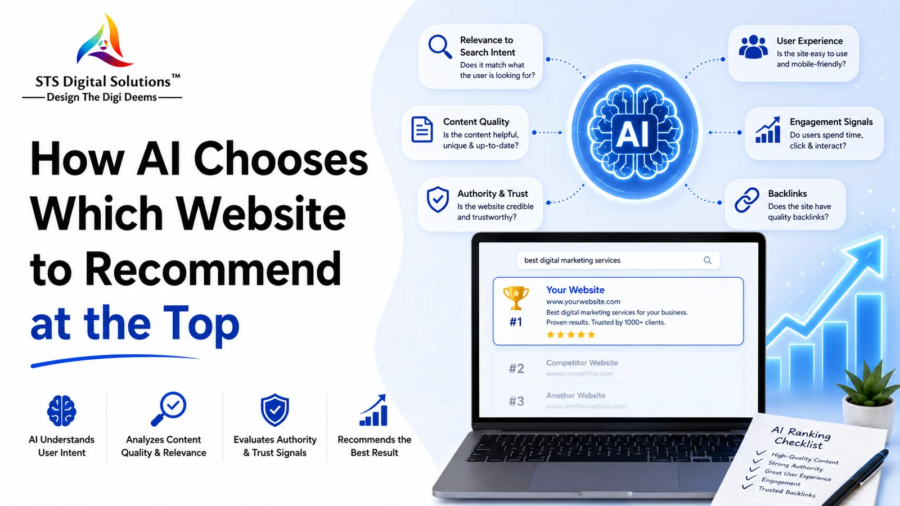
In reality, AI evaluates many signals together.
Some of the most important include:
- Content quality
- Search intent match
- EEAT signals
- Topical authority
- Semantic relevance
- Website trust
- User experience
- Content freshness
- Internal linking
- Structured organization
Think of AI as a researcher rather than a keyword counter. It wants to recommend information that is accurate, helpful, and easy for users to understand.
Factor #1: EEAT Is the Foundation
One of the strongest quality frameworks behind modern search is EEAT:
- Experience
- Expertise
- Authoritativeness
- Trustworthiness
These are not direct ranking factors by themselves, but they represent the qualities Google consistently encourages through its Search Quality guidance.
For example, a digital marketing agency that publishes practical insights, explains real-world strategies, keeps content updated, and clearly identifies its expertise is generally in a stronger position than a site that simply rewrites generic information.
For My Adwise, this means every article should answer one important question:
“Would a business owner trust us after reading this?”
If the answer is yes, you’re moving in the right direction.
Factor #2: Search Intent Matters More Than Keywords
Modern AI doesn’t just analyze the words on the page—it evaluates whether the content actually satisfies the user’s intent.
For example, someone searching:
is not looking for a dictionary definition.
They want to understand:
- How AI search works
- Why some websites are recommended
- What they can do to improve their own visibility
- Practical strategies they can implement
A page that fully answers those questions is more valuable than a page that simply repeats the target keyword dozens of times.
Key Takeaways
- AI search focuses on usefulness, not just keywords.
- EEAT helps establish credibility and trust.
- Matching user intent is more important than keyword repetition.
- Businesses should create content that genuinely solves problems instead of only targeting rankings.
- Long-term authority comes from consistent quality across your entire website.
How Google AI Overview Chooses Websites
Google AI Overview doesn’t recommend websites randomly. Every recommendation is based on multiple quality signals that help Google’s AI determine whether a page is accurate, trustworthy, and genuinely useful for users.
Unlike traditional search, where keyword optimization played a dominant role, AI-powered search focuses on understanding content quality, expertise, authority, and user intent before selecting a source.
In simple terms, Google’s AI asks one question:
“Which website provides the most complete, trustworthy, and helpful answer to this user’s question?”
If your content consistently answers that question better than competing pages, your chances of being referenced increase significantly.
AI Doesn't Read Content Like Humans
One of the biggest misconceptions in SEO is that AI reads an article from top to bottom the way people do.
It doesn’t.
Instead, AI analyzes the structure, context, relationships between topics, and overall usefulness of the content.
It evaluates questions such as:
- Does this page answer the user’s question?
- Is the information factually accurate?
- Does the content demonstrate real expertise?
- Is the website trustworthy?
- Is the information well organized?
- Does the page satisfy the search intent?
- Is the content current and relevant?
These signals work together to help AI decide whether your website deserves to be recommended.
The Seven Signals AI Looks For
1. Experience
Google increasingly values evidence of first-hand experience.
Rather than publishing generic advice, demonstrate that you’ve worked on real projects or encountered real business challenges.
For example, instead of writing:
SEO is important for ecommerce websites.
A stronger statement would be:
During technical SEO audits for ecommerce websites, we’ve frequently found that poor internal linking and duplicate product descriptions limit organic visibility. Correcting these issues often improves crawl efficiency and strengthens long-term search performance.
This approach demonstrates practical experience instead of repeating common advice.
2. Expertise
Expertise is reflected in the depth and accuracy of your content.
A high-quality article should explain not only what something is, but also why it matters and how to implement it successfully.
Expert-level content typically includes:
- Practical recommendations
- Step-by-step guidance
- Industry terminology explained clearly
- Common mistakes
- Actionable frameworks
- Real examples
The goal is to educate readers—not simply fill a page with keywords.
3. Authority
Authority develops over time.
Google and AI systems are more likely to trust websites that consistently publish valuable information within a specific niche.
Authority grows through:
- High-quality content
- Comprehensive topic coverage
- Internal content clusters
- Mentions from reputable websites
- Positive brand reputation
- Consistent publishing
Instead of trying to become an authority on everything, focus on becoming the most reliable resource within your area of expertise.
4. Trustworthiness
Trust is one of the strongest signals influencing both users and search engines.
Your website should clearly communicate that it represents a legitimate business.
Important trust signals include:
- HTTPS security
- Clear contact information
- About Us page
- Author information
- Privacy Policy
- Terms and Conditions
- Genuine customer reviews
- Transparent business details
These elements help visitors—and AI systems—feel more confident about your content.
5. Helpful Content
Google’s Helpful Content system rewards content created primarily for people rather than search engines.
Every article should answer real questions, solve genuine problems, and provide practical value.
Avoid writing content simply to rank for keywords.
Instead, focus on helping the reader accomplish their goal.
When users leave your page feeling informed and confident, you’re aligning with the direction modern search is moving.
6. Content Depth
Google’s Helpful Content system rewards content created primarily for people rather than search engines.
Every article should answer real questions, solve genuine problems, and provide practical value.
Avoid writing content simply to rank for keywords.
Instead, focus on helping the reader accomplish their goal.
When users leave your page feeling informed and confident, you’re aligning with the direction modern search is moving.
The strongest pages cover a topic comprehensively while remaining easy to understand.
For example, a basic article about Shopify SEO may only define the concept.
A comprehensive guide would also explain:
- Technical SEO
- Collection page optimization
- Product page optimization
- Site architecture
- Schema markup
- Internal linking
- AI Overview optimization
- Common mistakes
- Performance measurement
This level of depth provides significantly more value for readers.
7. User Satisfaction
Although Google doesn’t directly measure satisfaction as a single ranking factor, user behavior provides valuable feedback.
Positive engagement signals often include:
- Longer time spent on the page
- Higher click-through rates
- Visitors exploring additional pages
- Repeat visits
- Increased branded searches
These behaviors suggest that users found the content useful, which supports long-term search performance.
The My Adwise AI SEO Framework™
At My Adwise, we follow a structured approach to creating AI-friendly content.
Our framework consists of eight core principles:
A — Answer Real Questions
Every page should solve a specific user problem rather than simply target a keyword.
I — Intent First
Understand why someone is searching before creating content.
E — Experience
Support recommendations with practical insights whenever possible.
E — Expertise
Publish content that demonstrates deep knowledge instead of surface-level summaries.
A — Authority
Build topical authority through connected content clusters, service pages, and educational resources.
T — Trust
Maintain transparency through accurate information, business credibility, and consistent quality.
S — Structure
Organize content using clear headings, logical flow, internal links, and easy-to-read formatting.
This framework helps create content that serves both human readers and AI-powered search systems.
Key Takeaways
Modern AI doesn’t recommend websites simply because they rank well for a keyword.
Instead, it evaluates whether a page is trustworthy, comprehensive, well-structured, and genuinely helpful.
Businesses that consistently publish experience-driven, high-quality content while building topical authority are better positioned to earn visibility in Google AI Overview and other AI-powered search experiences.
Entity SEO, Semantic SEO, and Topical Authority: The Future of AI Search
Search engines no longer evaluate individual keywords in isolation. Modern AI systems understand relationships between topics, concepts, brands, and entities to determine whether a website genuinely demonstrates expertise.
This is why three concepts have become increasingly important for businesses:
- Entity SEO
- Semantic SEO
- Topical Authority
Together, these help AI understand what your website is about, whether it can be trusted, and when it should be recommended.
What Is Entity SEO?
An entity is a uniquely identifiable person, company, place, product, service, or concept.
Instead of relying only on keywords, Google’s AI understands entities and the relationships between them.
For example, if your agency regularly publishes content about:
- SEO
- Shopify SEO
- Technical SEO
- Local SEO
- Content Marketing
- Google Ads
- Meta Ads
- AI Overview
- AEO
- GEO
Google begins associating My Adwise with digital marketing expertise rather than viewing your website as a collection of unrelated pages.
That association becomes increasingly valuable as your content grows.
Why Semantic SEO Matters
Traditional SEO often focused on repeating one keyword throughout a page.
Semantic SEO focuses on covering an entire topic naturally.
Instead of repeating:
Shopify SEO
twenty times, a comprehensive article should naturally include related concepts such as:
- Ecommerce SEO
- Product Page Optimization
- Collection Page SEO
- Internal Linking
- Structured Data
- Core Web Vitals
- Search Intent
- AI Overview
- Product Schema
This creates richer context and helps search engines understand the complete subject.
The result is content that feels more natural for readers while providing stronger contextual signals for AI.
Build Topical Authority, Not Isolated Articles
One excellent article rarely builds authority on its own.
Search engines look for consistent expertise across an entire website.
Instead of publishing random topics, organize your content into connected clusters.
For My Adwise, the structure might look like this:
Pillar Page
Supporting Articles
- What Is Agentic SEO?
- Why AEO and GEO Matter
- How Google AI Overview Works
- AI SEO for Ecommerce
- AI SEO for Local Businesses
- Technical SEO for AI Search
- EEAT Best Practices
- Semantic SEO Explained
Each supporting article should link back to the pillar page, while the pillar page links to the supporting resources.
This strengthens topical authority and helps search engines understand the depth of your expertise.
Schema Markup Helps AI Understand Your Content
Schema markup provides structured information that helps search engines interpret your pages more accurately.
Although schema alone won’t guarantee higher rankings, it improves clarity and supports rich search experiences.
For informational articles, consider implementing:
- Article Schema
- FAQ Schema
- Breadcrumb Schema
- Organization Schema
- Author Schema
Combined with high-quality content, structured data improves how search engines interpret your website.
Common Mistakes That Prevent AI Recommendations
Many businesses unknowingly reduce their chances of appearing in AI-powered search by making avoidable mistakes.
Some of the most common include:
- Publishing thin or generic AI-generated content without expert review.
- Chasing keywords instead of solving user problems.
- Ignoring EEAT principles.
- Weak internal linking.
- Outdated articles that are never refreshed.
- Duplicate product or service descriptions.
- Poor mobile experience.
- Slow-loading pages.
- Missing author information and business credibility signals.
Avoiding these issues is often just as important as publishing new content.
An AI SEO Checklist for 2026
Before publishing any article, ask yourself:
✓ Does it fully answer the user’s question?
✓ Does it demonstrate real expertise?
✓ Is the information accurate and current?
✓ Is the content organized with clear headings?
✓ Are important related topics covered naturally?
✓ Does the article include helpful internal links?
✓ Is the page fast and mobile-friendly?
✓ Have you added appropriate schema markup?
✓ Would you confidently recommend this article to a client?
If the answer to most of these questions is “yes,” you’re creating content that aligns with the direction of modern search.
Frequently Asked Questions
Can AI-generated content rank on Google?
Yes, but only if it is accurate, genuinely helpful, carefully reviewed, and enhanced with original insights. Publishing raw AI output without human expertise often results in lower-quality content.
Is SEO still relevant after Google AI Overview?
Absolutely.
SEO has not disappeared—it has evolved.
Businesses now need to optimize not only for traditional rankings but also for AI-powered search experiences.
Which matters more: backlinks or content?
Both remain important.
High-quality content establishes relevance and expertise, while authoritative backlinks strengthen credibility.
The strongest websites invest in both.
How often should AI SEO content be updated?
Review important pages every few months or whenever meaningful industry changes occur. Keeping content current improves accuracy and user trust.
Final Thoughts
The future of search isn’t about manipulating algorithms—it’s about becoming the most reliable source of information in your niche.
Businesses that consistently publish accurate, experience-driven, and user-focused content will be better positioned for both traditional Google Search and AI-powered discovery.
Rather than chasing every algorithm update, invest in creating resources that genuinely help people make better decisions.
That strategy is more sustainable, builds long-term authority, and creates stronger relationships with both users and search engines.
As AI continues to reshape how information is discovered, trust will become one of the most valuable competitive advantages any business can build.
Ready to Prepare Your Business for AI Search?
If you want your business to improve visibility in Google Search, Google AI Overview, and other AI-powered search platforms, the team at My Adwise can help.
We specialize in:
- SEO Strategy
- AI SEO
- Answer Engine Optimization (AEO)
- Generative Engine Optimization (GEO)
- Technical SEO
- Shopify SEO
- Content Strategy
- Digital Marketing Consulting
Our focus isn’t simply on increasing rankings—it’s on building long-term organic visibility that drives qualified traffic, generates leads, and supports sustainable business growth.
The businesses that adapt to AI search today will be the ones leading their industries tomorrow.