
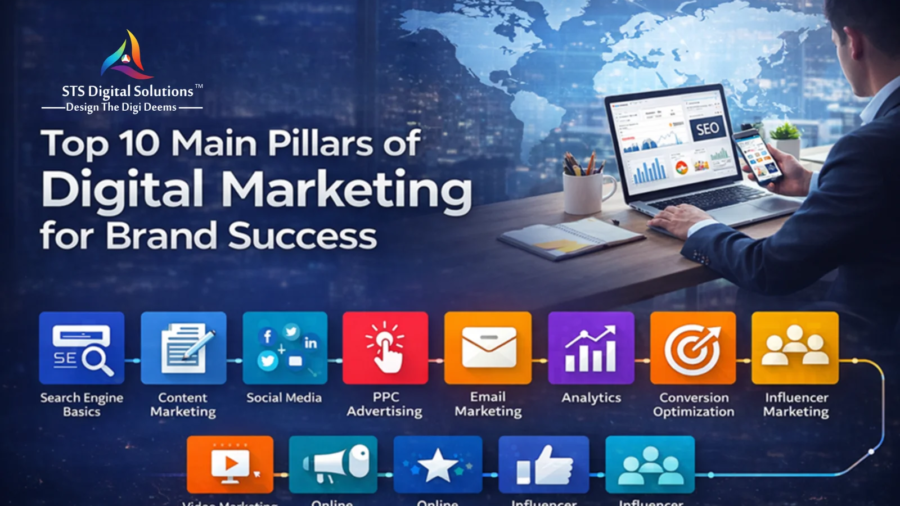
Successful digital marketing is built on a combination of SEO, content marketing, paid advertising, social media, email marketing, analytics, conversion optimization, branding, customer experience, and AI-powered automation. Businesses that integrate these pillars into one unified strategy are better positioned to generate consistent traffic, qualified leads, and long-term growth.
Introduction
There was a time when businesses could depend on a single marketing channel—ranking on Google, running Facebook Ads, or sending email campaigns—and still achieve impressive results.
That approach no longer works.
Today’s customers interact with businesses across multiple platforms before making a buying decision. They may discover your brand through Instagram, search for reviews on Google, read your blog, subscribe to your email list, and only then decide to contact you or make a purchase.
This means digital marketing is no longer about mastering one platform. It is about building an integrated system where every marketing channel supports the others.
At My Adwise, we believe sustainable business growth comes from combining multiple strategies rather than relying on a single source of traffic. Businesses that build this foundation are more resilient to algorithm updates, advertising cost increases, and changing customer behaviour.
Let’s explore the ten pillars that support long-term digital marketing success.
1. Search Engine Optimization (SEO)
SEO remains one of the most valuable long-term marketing investments.
Unlike paid advertising, SEO continues generating traffic long after content is published.
An effective SEO strategy includes:
- Keyword research based on user intent
- Technical SEO
- High-quality content
- Internal linking
- Page speed optimization
- Mobile-friendly design
- EEAT-focused content
As AI-powered search continues to evolve, SEO is becoming less about keywords and more about providing the best possible answer to users.
2. Content Marketing
Content is the foundation of every successful digital marketing strategy.
Helpful content attracts visitors, answers questions, builds trust, and supports every stage of the customer journey.
Examples include:
- Blog articles
- Buying guides
- Case studies
- Videos
- Infographics
- Industry reports
- FAQs
Rather than publishing content simply to increase page count, businesses should focus on solving real customer problems.
3. Paid Advertising (PPC)
Paid advertising delivers immediate visibility.
Platforms such as Google Ads and Meta Ads help businesses:
- Generate leads quickly
- Promote new products
- Test new audiences
- Increase brand awareness
- Retarget previous visitors
However, paid advertising performs best when combined with strong landing pages, compelling content, and ongoing conversion optimization.
Depending entirely on paid ads can become expensive as competition increases.
Why These Three Pillars Work Together
Many businesses mistakenly treat SEO, content marketing, and paid advertising as separate activities.
In reality, they are most effective when they support one another.
For example:
- SEO attracts long-term organic visitors.
- Content marketing educates and builds trust.
- Paid advertising accelerates visibility and captures immediate demand.
Together, these channels create a balanced marketing strategy that supports sustainable growth.
Key Takeaways
- SEO builds long-term organic visibility.
- Content marketing establishes authority and trust.
- Paid advertising delivers immediate traffic and testing opportunities.
- The strongest businesses combine multiple marketing channels instead of relying on only one.
- Sustainable digital marketing is built on systems, not shortcuts.
4. Social Media Marketing
-
Social media is no longer just a platform for posting content—it’s a channel for building relationships.
Today’s consumers expect brands to educate, engage, and interact consistently across platforms such as LinkedIn, Instagram, Facebook, X, and YouTube.
A successful social media strategy should focus on:
- Sharing educational content
- Building brand awareness
- Creating meaningful conversations
- Showcasing customer success stories
- Promoting valuable resources
- Strengthening community engagement
Rather than chasing viral posts, businesses should aim for consistent communication that builds long-term trust.
5. Email Marketing
-
Despite the growth of new marketing channels, email remains one of the highest ROI digital marketing strategies.
Unlike social media, where algorithms control visibility, email allows businesses to communicate directly with their audience.
Effective email campaigns can be used to:
- Welcome new subscribers
- Nurture leads
- Share educational content
- Promote products and services
- Recover abandoned carts
- Encourage repeat purchases
The key is to provide value instead of sending constant promotional messages.
6. Conversion Rate Optimization (CRO)
-
Driving traffic is only part of the marketing process.
If visitors leave without taking action, marketing budgets become less efficient.
Conversion Rate Optimization focuses on improving the percentage of visitors who complete meaningful actions, such as:
- Submitting a contact form
- Booking a consultation
- Purchasing a product
- Downloading a resource
- Subscribing to a newsletter
Simple improvements—clear headlines, faster loading pages, better calls to action, and stronger trust signals—can significantly improve conversion performance.
7. Analytics and Data
-
Successful marketing decisions should be based on data, not assumptions.
Businesses should regularly monitor metrics such as:
- Organic traffic
- Conversion rate
- Customer Acquisition Cost (CAC)
- Customer Lifetime Value (LTV)
- Return on Ad Spend (ROAS)
- Bounce rate
- Engagement rate
Analytics helps identify what is working, what needs improvement, and where future investments should be focused.
8. Brand Positioning
-
Marketing attracts attention.
Branding creates recognition.
Customers are more likely to choose businesses that communicate a clear identity and value proposition.
Strong brands maintain consistency across:
- Website messaging
- Social media
- Visual identity
- Customer communication
- Advertising campaigns
- Content marketing
When every touchpoint reflects the same message, customers remember the brand more easily.
9. AI-Powered Marketing
-
Artificial intelligence is transforming how businesses plan, create, and optimize marketing campaigns.
AI can support:
- Keyword research
- Content planning
- Customer segmentation
- Marketing automation
- Campaign analysis
- Predictive insights
However, AI should enhance human expertise—not replace it.
Businesses that combine AI efficiency with human creativity and strategic thinking are likely to achieve the best results.
10. Customer Experience (CX)
-
The final pillar—and often the most overlooked—is customer experience.
Every interaction influences how customers perceive your business.
A positive experience includes:
- Fast website performance
- Mobile-friendly design
- Easy navigation
- Clear pricing
- Transparent policies
- Responsive customer support
- Smooth checkout process
- Helpful post-purchase communication
Excellent customer experience increases trust, encourages repeat business, and strengthens long-term brand loyalty.
Why These Ten Pillars Matter Together
-
Many businesses focus heavily on one marketing channel while ignoring the others.
For example:
- Strong advertising without SEO creates ongoing dependence on paid traffic.
- Great SEO without conversion optimization limits revenue.
- High-quality content without branding reduces recognition.
- Good traffic without analytics makes it difficult to improve performance.
The most successful businesses build an integrated marketing ecosystem where each pillar supports the others.
This balanced approach creates stronger resilience, better customer relationships, and more sustainable growth.
A Practical Digital Marketing Checklist
-
Before launching your next campaign, ask yourself:
✔ Is your website technically optimized?
✔ Are you creating content that genuinely helps your audience?
✔ Are your paid campaigns aligned with your business goals?
✔ Is your social media building trust instead of only promoting products?
✔ Are you nurturing leads through email marketing?
✔ Have you optimized your website for conversions?
✔ Are you measuring the right performance metrics?
✔ Does your brand communicate a clear value proposition?
✔ Are you using AI to improve efficiency without sacrificing quality?
✔ Is your customer experience consistent across every touchpoint?
Businesses that can confidently answer “yes” to these questions are often better positioned for long-term digital success.
Key Takeaways
- Social media should build relationships, not just visibility.
- Email marketing remains one of the highest ROI channels.
- Conversion optimization increases the value of existing traffic.
- Analytics enables better decision-making.
- Strong branding creates recognition and trust.
- AI enhances marketing efficiency when guided by human expertise.
- Customer experience influences both conversions and long-term loyalty.
The My Adwise Digital Growth Framework™
At My Adwise, we believe that successful digital marketing is not built around a single channel. Instead, it is the result of multiple strategies working together to create a consistent customer journey.
Our Digital Growth Framework consists of six core stages:
1. Build Visibility
Visibility comes from:
- Search Engine Optimization (SEO)
- AI Search Optimization
- Google Business Profile
- Social Media
- Paid Advertising
- Content Marketing
The goal is to ensure your brand appears wherever potential customers are searching for solutions.
2. Build Trust
Traffic alone doesn’t generate revenue.
People buy from businesses they trust.
Trust is established through:
- Helpful educational content
- Customer reviews
- Case studies
- Transparent pricing
- Secure website experience
- Professional branding
- Demonstrated expertise
Businesses that consistently educate their audience usually convert more visitors into customers.
3. Generate Qualified Leads
Not every visitor is a potential customer.
A successful marketing strategy focuses on attracting qualified prospects rather than maximizing traffic alone.
Lead generation channels include:
- SEO
- Google Ads
- Meta Ads
- Landing pages
- Lead magnets
- Contact forms
- Consultation booking pages
The objective is to connect with people who are already looking for your products or services.
4. Improve Conversion Rates
Generating leads is only part of the process.
Your website should make it easy for visitors to take the next step.
Effective conversion optimization includes:
- Clear calls to action
- Simple navigation
- Fast-loading pages
- Trust badges
- Testimonials
- Easy-to-complete forms
- Mobile-friendly design
Small improvements often create significant increases in overall performance.
5. Retain Existing Customers
Acquiring a customer is usually more expensive than keeping one.
Retention strategies include:
- Email newsletters
- Loyalty programs
- Personalized recommendations
- Exclusive offers
- Educational resources
- Excellent customer support
Long-term business growth depends on building lasting customer relationships.
6. Measure, Improve, Repeat
Digital marketing is never a one-time activity.
Review your performance regularly.
Monitor:
- Organic traffic
- Lead quality
- Conversion rates
- Customer Acquisition Cost (CAC)
- Customer Lifetime Value (LTV)
- Return on Investment (ROI)
Use these insights to improve future campaigns instead of relying on assumptions.
Common Digital Marketing Mistakes
Many businesses struggle because they make avoidable mistakes such as:
- Depending entirely on paid advertising.
- Ignoring SEO.
- Publishing low-quality or duplicate content.
- Failing to understand customer intent.
- Inconsistent branding.
- Poor website performance.
- Weak calls to action.
- Not tracking marketing performance.
- Neglecting customer retention.
- Chasing trends without a long-term strategy.
Avoiding these mistakes can improve both marketing efficiency and long-term business growth.
The Future of Digital Marketing
Digital marketing is becoming increasingly driven by artificial intelligence, automation, and personalized customer experiences.
Businesses that want to remain competitive should focus on:
- AI-powered search optimization
- Helpful, experience-driven content
- First-party customer data
- Marketing automation
- Video-first communication
- Personalization
- Strong brand authority
- Continuous learning and experimentation
Rather than trying to adapt to every algorithm update, build a marketing strategy that consistently delivers value to your audience.
Frequently Asked Questions
Which digital marketing channel delivers the best ROI?
There is no single answer. The best-performing strategy depends on your business model, industry, and goals. In most cases, combining SEO, content marketing, paid advertising, and email marketing delivers stronger long-term results than relying on one channel.
Is SEO still important in 2026?
Absolutely.
SEO continues to be one of the most valuable long-term marketing investments. As AI-powered search evolves, businesses that publish trustworthy, experience-driven content are likely to gain even greater visibility.
How does AI affect digital marketing?
AI helps businesses improve efficiency through content planning, campaign optimization, audience analysis, and automation.
However, human expertise remains essential for strategy, creativity, and decision-making.
Should small businesses invest in digital marketing?
Yes.
Digital marketing allows small businesses to compete with larger organizations by reaching targeted audiences, building trust, and generating qualified leads without requiring massive advertising budgets.
Final Thoughts
Digital marketing is no longer about mastering a single platform or chasing the latest trend.
Sustainable business growth comes from building a connected system where SEO, content marketing, paid advertising, social media, email marketing, analytics, branding, customer experience, and AI work together toward a common objective.
Businesses that focus on delivering genuine value, understanding customer needs, and continuously improving their marketing strategy will be better positioned to succeed in an increasingly competitive digital landscape.
The companies that thrive over the next decade won’t necessarily be the ones spending the most on advertising—they’ll be the ones building the strongest digital foundations.
Why Choose My Adwise?
At My Adwise, we help businesses create sustainable growth through a complete digital marketing strategy tailored to their goals.
Our services include:
- Search Engine Optimization (SEO)
- AI Search Optimization
- Answer Engine Optimization (AEO)
- Generative Engine Optimization (GEO)
- Google Ads Management
- Meta Ads Management
- Shopify SEO
- Content Marketing
- Technical SEO
- Conversion Rate Optimization (CRO)
Instead of focusing only on rankings or clicks, we help businesses build long-term visibility, generate qualified leads, and create measurable business growth through data-driven digital marketing strategies.
Whether you’re a startup, a growing D2C brand, or an established business, the right strategy can transform your online presence into a consistent source of customers.
The future of digital marketing belongs to businesses that educate, build trust, and adapt faster than the competition. Start building that foundation today.